
 +91 8420731759
Introduction
Artificial Intelligence (AI) is no longer a futuristic concept—it’s the backbone of modern enterprises. From customer support chatbots to financial advisory systems, AI applications are reshaping industries. Yet, as adoption accelerates, businesses face persistent challenges:
- Scalability bottlenecks in multi-user environments
- Hallucinations from large language models (LLMs)
- Outdated knowledge bases that reduce reliability
- Enterprise adoption hurdles around compliance and cost
Enter Retrieval-Augmented Generation (RAG)—a breakthrough architecture that combines the power of generative AI with dynamic knowledge retrieval. RAG is rapidly becoming the gold standard for building scalable AI systems that are accurate, cost-efficient, and enterprise-ready.
At Softquake Systems Pvt. Ltd., we specialize in designing intelligent automation solutions and enterprise AI applications. This article explores how RAG enables businesses to build scalable, reliable, and future-ready AI systems.
What is Retrieval-Augmented Generation (RAG)?
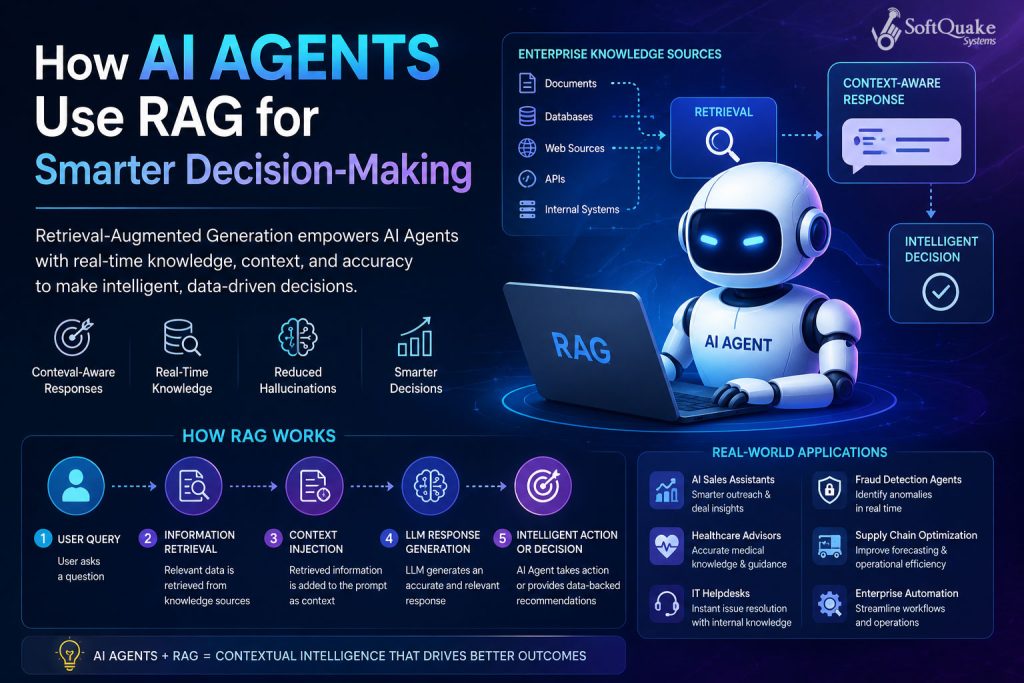
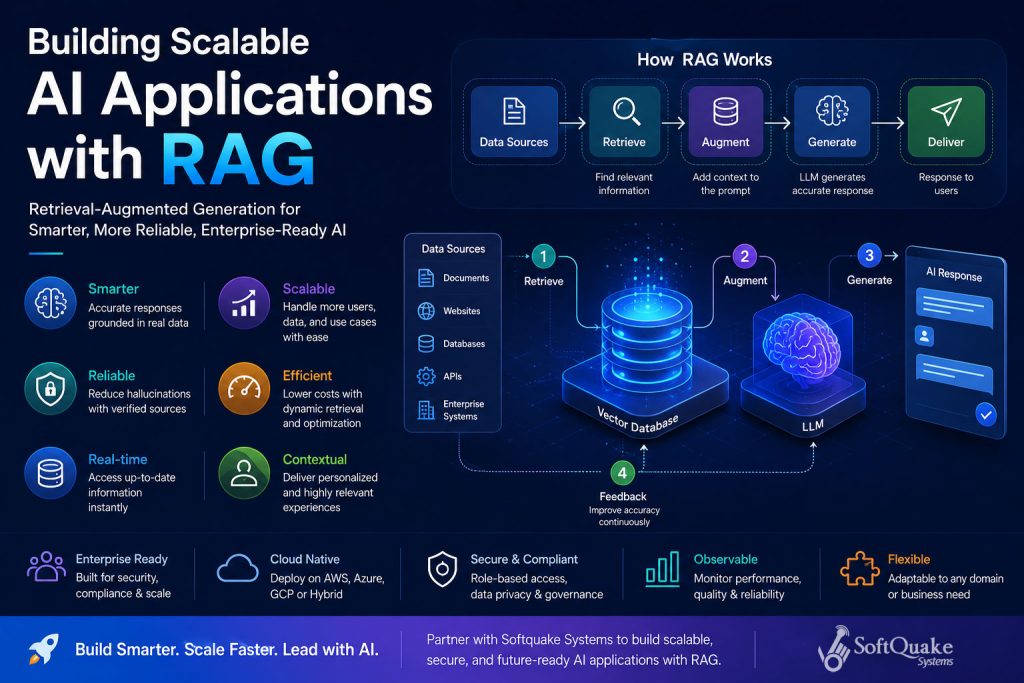
RAG is an AI architecture that enhances generative models by integrating retrieval mechanisms. Instead of relying solely on pre-trained knowledge, RAG fetches relevant information from external sources (like vector databases) before generating responses.
- Traditional LLMs: Generate answers based only on training data.
- RAG-powered systems: Retrieve fresh, domain-specific knowledge, then generate contextually accurate responses.
Analogy: Imagine asking a friend about a topic. A traditional LLM is like a friend who remembers everything they studied years ago. RAG is like a friend who quickly checks the latest encyclopedia before answering—accurate, updated, and reliable.
Why Scalability Matters in AI Applications
Enterprise AI adoption is exploding. Gartner predicts that over 80% of enterprises will deploy generative AI by 2026. Scalability is critical because:
- Data volumes are growing exponentially
- Multi-user environments demand real-time responses
- Knowledge updates must be instant
- Performance bottlenecks increase costs
Traditional AI systems struggle to scale because they rely on static training data. RAG solves this by dynamically retrieving knowledge, reducing retraining costs, and enabling real-time enterprise intelligence.
Core Components of a Scalable RAG Architecture
| Component | Role in RAG Architecture |
|---|---|
| Data Ingestion Pipeline | Collects and structures enterprise data for retrieval |
| Document Preprocessing | Cleans, chunks, and formats documents for embeddings |
| Embedding Models | Converts text into vector representations for search |
| Vector Databases | Stores embeddings for fast retrieval (e.g., Pinecone, Weaviate, FAISS) |
| Retrieval Systems | Fetches relevant documents based on queries |
| Re-ranking Mechanisms | Prioritizes the most relevant results |
| Large Language Models | Generates natural language responses |
| Prompt Orchestration | Structures queries and responses for accuracy |
| Response Generation Layer | Delivers final output to users |
| Monitoring & Feedback | Tracks performance, accuracy, and user satisfaction |
This modular architecture ensures scalability, reliability, and adaptability across industries.
How RAG Enables Scalable AI Applications
RAG transforms enterprise AI by offering:
- Dynamic knowledge retrieval → Always up-to-date responses
- Reduced hallucinations → Higher accuracy and trust
- Lower training costs → No need for frequent retraining
- Real-time updates → Instant integration of new data
- Better contextual understanding → Personalized experiences
- Faster deployment cycles → Agile enterprise rollouts
- Multi-domain adaptability → Works across industries
Example: A financial advisory chatbot using RAG can instantly pull the latest market data, ensuring clients receive real-time, compliant, and personalized insights.
Enterprise Use Cases of RAG
1. AI Customer Support Chatbots
- Problem: Static chatbots fail with complex queries.
- RAG Solution: Retrieves updated FAQs, policies, and product manuals.
- Scalability Advantage: Handles thousands of queries simultaneously.
2. Healthcare Knowledge Assistants
- Problem: Doctors need real-time medical references.
- RAG Solution: Fetches latest research papers and treatment guidelines.
- Scalability Advantage: Supports multi-specialty hospitals.
3. Legal Document Analysis
- Problem: Legal teams struggle with massive document sets.
- RAG Solution: Retrieves case law and statutes for contextual analysis.
- Scalability Advantage: Reduces research time across firms.
4. Financial Advisory Systems
- Problem: Market data changes rapidly.
- RAG Solution: Integrates live feeds with generative insights.
- Scalability Advantage: Supports global advisory networks.
(Other use cases: eCommerce, HR support, pharmaceutical knowledge management, internal enterprise search.)
Choosing the Right Tech Stack for RAG Applications
Popular technologies include:
- Vector Databases: Pinecone, Weaviate, FAISS
- LLM Providers: OpenAI, Azure AI, AWS Bedrock
- Frameworks: LangChain, LlamaIndex
- Infrastructure: Cloud-native (AWS, Azure, GCP)
When to choose:
- Pinecone: Best for enterprise-grade scalability
- Weaviate: Strong semantic search capabilities
- FAISS: Lightweight, open-source option
- LangChain/LlamaIndex: Ideal for orchestration and modular workflows
Best Practices for Building Scalable RAG Systems
- Ensure data quality management
- Use chunking strategies for documents
- Optimize retrieval latency
- Implement hybrid search (semantic + keyword)
- Enforce access control for compliance
- Add observability and monitoring
- Continuously evaluate accuracy
- Optimize costs with dynamic scaling
- Prioritize security and governance
Common Challenges in RAG Implementation
- Poor retrieval accuracy → Solve with better embeddings
- Data silos → Use unified ingestion pipelines
- Scaling vector databases → Choose cloud-native solutions
- High inference costs → Optimize prompts and caching
- Data privacy concerns → Implement encryption and compliance checks
- Complex orchestration → Use frameworks like LangChain
- Maintaining low latency → Deploy edge caching
- Prompt injection risks → Apply strict validation
Future of Scalable AI with RAG
The next frontier includes:
- Agentic AI systems → Autonomous enterprise assistants
- Multi-modal RAG → Text, image, and video retrieval
- Real-time enterprise intelligence → Continuous updates
- Personalized AI ecosystems → Tailored enterprise copilots
- Hybrid AI architectures → Combining symbolic and neural AI
RAG will be the foundation of enterprise AI scalability in the coming decade.
Conclusion
RAG is revolutionizing how enterprises build scalable AI applications. By combining retrieval with generation, businesses achieve accuracy, adaptability, and cost efficiency.
At Softquake Systems Pvt. Ltd., we help enterprises design AI-powered solutions that are future-ready, secure, and scalable. Partner with us to unlock the full potential of Retrieval-Augmented Generation in your business.
Ready to build scalable AI applications? Softquake Systems Pvt. Ltd. offers:
- AI application development
- Enterprise AI solutions
- RAG implementation services
- AI chatbot development
- Custom software engineering
Contact us today to transform your enterprise with intelligent automation.
FAQ Section
1. What is RAG in AI?
Retrieval-Augmented Generation (RAG) combines knowledge retrieval with generative AI, ensuring responses are accurate, updated, and context-aware.
2. Why is RAG important for scalable AI?
RAG reduces hallucinations, lowers retraining costs, and enables real-time knowledge integration—critical for enterprise scalability.
3. How do vector databases work in RAG?
Vector databases store embeddings (numerical representations of text) and allow fast similarity searches, enabling RAG to retrieve relevant knowledge instantly.
4. What industries benefit most from RAG?
Healthcare, finance, legal, eCommerce, HR, and pharmaceuticals benefit significantly due to their reliance on dynamic, large-scale knowledge retrieval.
5. Is RAG better than fine-tuning?
Yes, for scalability. Fine-tuning requires retraining models, while RAG dynamically retrieves knowledge, reducing costs and improving adaptability.