
 +91 8420731759
In today’s highly competitive digital economy, businesses rely on technology more than ever before. From customer relationship management and inventory tracking to financial reporting and operational workflows, software plays a critical role in driving efficiency and growth.
Most organizations begin their digital journey using off-the-shelf software solutions. These tools are often affordable, easy to implement, and sufficient for managing basic operations during the early stages of growth.
However, as businesses expand, processes become more complex. Teams grow larger, customer expectations increase, and operational requirements become more sophisticated. What once worked perfectly can quickly become a bottleneck.
Many organizations eventually discover that their software is no longer supporting growth—it is slowing it down.
This is where Custom Software Development becomes a strategic investment rather than a technology expense.
Custom software is specifically designed around your business processes, goals, and workflows. Instead of forcing your operations to fit within the limitations of generic software, a custom solution adapts to the way your business works.
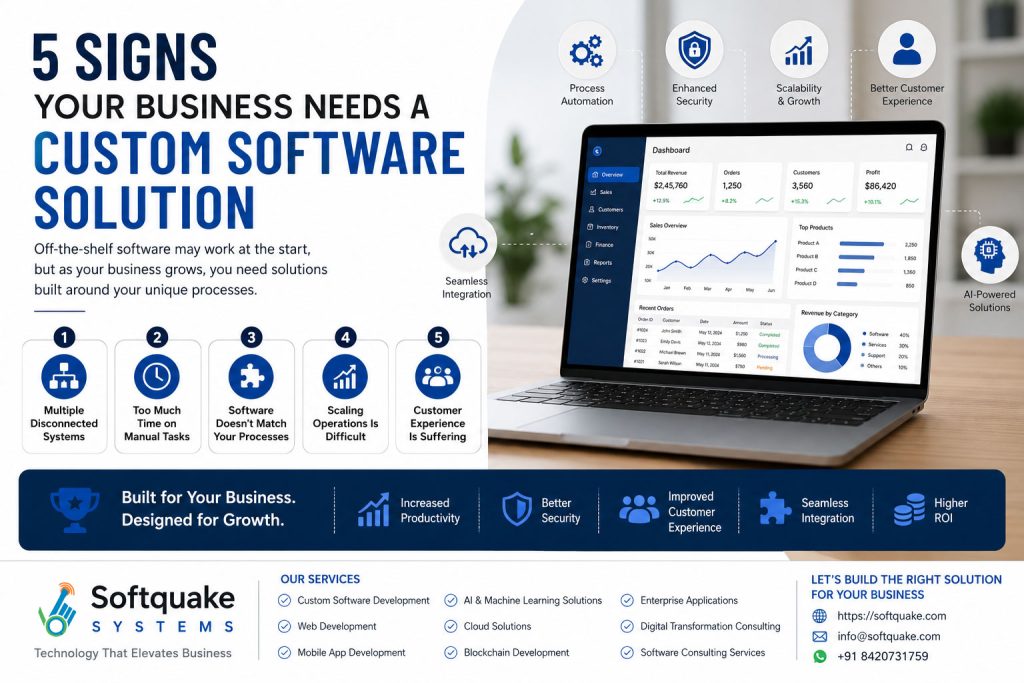
If you’re unsure whether your organization has reached that point, here are five clear warning signs that indicate it’s time to consider a custom software solution.
Sign #1: Your Team Relies on Multiple Disconnected Systems
One of the most common indicators that a business has outgrown its existing software ecosystem is the use of multiple disconnected applications.
Many organizations operate using a combination of:
- CRM systems
- Accounting software
- Inventory management tools
- Customer support platforms
- Marketing automation systems
- Project management applications
While each tool may perform its specific function effectively, problems arise when they cannot communicate with one another.
The Problem
Disconnected systems create:
Data Silos
Information becomes trapped within separate applications, making it difficult to access accurate business insights.
Duplicate Data Entry
Employees often enter the same information multiple times across different systems.
Manual Data Transfers
Teams waste valuable hours exporting and importing spreadsheets between platforms.
Inconsistent Reporting
Different departments may generate conflicting reports because data is stored in multiple locations.
Business Example
Consider an e-commerce company.
Its sales team uses one CRM platform, accounting uses another application, inventory is managed separately, and customer support relies on yet another system.
When a customer places an order:
- Sales updates customer records
- Inventory updates stock levels
- Finance processes payments
- Support manages customer requests
Without integration, employees must manually update information across multiple systems.
This increases the likelihood of:
- Errors
- Delays
- Customer dissatisfaction
The Cost of Disconnected Systems
Research consistently shows that employees spend a significant portion of their workday searching for information and manually managing data.
These inefficiencies create:
- Higher operational costs
- Slower decision-making
- Reduced productivity
- Poor customer experiences
How Custom Software Solves This Problem
A custom software solution can unify all critical business functions into a centralized platform.
Benefits include:
- Real-time data synchronization
- Single source of truth
- Automated information flow
- Improved collaboration
- Better reporting accuracy
Instead of managing five separate applications, your team operates from one integrated system designed around your business needs.
This is one of the biggest advantages of modern Enterprise Software Development.
Sign #2: Employees Spend Too Much Time on Manual Tasks
If your employees spend hours performing repetitive administrative work, your business is likely losing valuable productivity.
Manual processes are often hidden growth killers.
Common Manual Activities
Many organizations still rely heavily on:
- Spreadsheet updates
- Data entry
- Report generation
- Approval workflows
- Invoice processing
- Customer onboarding
- Status tracking
Although these tasks appear manageable individually, they consume significant resources over time.
The Productivity Problem
Employees should focus on:
- Customer engagement
- Innovation
- Revenue generation
- Strategic planning
Instead, many spend large portions of their day completing repetitive activities.
This creates:
- Employee frustration
- Increased operational costs
- Human errors
- Delayed business processes
Business Example
A manufacturing company receives purchase orders via email.
Employees manually:
- Enter order information
- Verify inventory
- Generate invoices
- Send approvals
- Update reports
What should take minutes often requires hours.
As order volume increases, the inefficiencies multiply.
Risks of Manual Processes
Manual workflows create several business risks:
Human Error
Even experienced employees make mistakes when handling repetitive tasks.
Scalability Challenges
More business often requires more staff.
Delayed Decision-Making
Leaders cannot access real-time operational insights.
Compliance Risks
Industries like healthcare and financial services require accurate documentation and audit trails.
How Custom Software Solves This Problem
Custom software enables Business Process Automation and Workflow Automation.
Examples include:
- Automated approvals
- Intelligent notifications
- Digital document management
- Automated reporting
- AI-powered data processing
By automating routine tasks, organizations can:
- Reduce costs
- Improve efficiency
- Increase employee satisfaction
- Accelerate growth
This is where AI Software Development and automation technologies deliver measurable ROI.
Sign #3: Your Current Software Doesn’t Match Your Business Processes
Every successful business develops unique workflows that contribute to its competitive advantage.
Unfortunately, most off-the-shelf software is designed for mass-market use.
As a result, businesses are often forced to change their processes to fit the software rather than the other way around.
Common Warning Signs
You may notice:
- Excessive workarounds
- Multiple spreadsheets supporting software gaps
- Missing features
- Complicated processes
- Employee complaints
These symptoms indicate that your software is no longer aligned with operational requirements.
The Hidden Cost of Workarounds
Workarounds create inefficiencies that become embedded into daily operations.
Examples include:
- Exporting reports to Excel for analysis
- Tracking approvals through email
- Maintaining separate databases
- Creating duplicate records
Over time, these workarounds increase complexity and operational risk.
Business Example
A healthcare provider may require:
- Specialized patient workflows
- Regulatory compliance features
- Custom reporting requirements
- Secure document management
Generic healthcare software may support some needs but not all.
Employees then develop manual processes to bridge functionality gaps.
This increases costs and decreases efficiency.
Why Off-the-Shelf Software Falls Short
Generic software serves thousands of businesses.
Your organization has:
- Unique processes
- Industry requirements
- Customer expectations
- Strategic objectives
No standard platform can perfectly accommodate every business model.
How Custom Software Solves This Problem
Custom Application Development starts with understanding how your business operates.
The software is then designed around:
- Existing workflows
- Department requirements
- Industry regulations
- Growth objectives
Benefits include:
- Increased efficiency
- Improved user adoption
- Reduced training requirements
- Greater operational flexibility
Instead of adapting your business to software limitations, the software adapts to your business.
Sign #4: Scaling Operations Has Become Difficult
Growth is exciting.
However, growth often exposes technology limitations.
A system that performs well for 10 users may struggle with 500 users.
A platform handling 100 transactions daily may become unreliable when processing 10,000.
Indicators of Scaling Problems
Watch for:
- Slow system performance
- Frequent outages
- Data processing delays
- User limitations
- Reporting bottlenecks
These issues can significantly impact growth initiatives.
Business Example
A rapidly growing real estate company expands into multiple regions.
Its existing software struggles to:
- Manage additional users
- Process larger datasets
- Support new locations
- Integrate third-party services
The result is slower operations and reduced visibility across the organization.
Why Scalability Matters
Technology should enable growth, not restrict it.
Organizations planning expansion need systems capable of supporting:
- New customers
- Additional employees
- Multiple locations
- New products
- International operations
Without scalable technology, growth becomes increasingly difficult and expensive.
How Custom Software Solves This Problem
Modern Enterprise Technology Solutions are built with scalability in mind.
Custom platforms can include:
- Cloud-native architecture
- Modular design
- API integrations
- Distributed infrastructure
- High-performance databases
Benefits include:
- Improved reliability
- Faster performance
- Future-proof architecture
- Reduced downtime
As your business grows, your software grows with it.
This is one of the key advantages of professional Business Software Development.
Sign #5: Customer Experience Is Suffering
Customer experience has become a major competitive differentiator.
Today’s customers expect:
- Fast service
- Personalized interactions
- Accurate information
- Seamless experiences
If your software prevents your team from meeting these expectations, customer satisfaction will decline.
Common Customer Experience Challenges
Businesses often face:
- Slow response times
- Fragmented customer information
- Delayed order processing
- Communication gaps
- Inconsistent service delivery
Business Example
A financial services company manages customer data across multiple systems.
When customers contact support:
- Representatives cannot access complete histories
- Information must be gathered manually
- Resolution times increase
The customer experiences frustration.
The business risks losing trust and revenue.
The Business Impact
Poor customer experiences can result in:
- Lower retention rates
- Negative reviews
- Reduced referrals
- Increased acquisition costs
In competitive industries, these outcomes can significantly impact profitability.
How Custom Software Solves This Problem
Custom software enables a unified customer experience.
Capabilities may include:
- Centralized customer profiles
- Automated communication workflows
- Self-service portals
- Mobile applications
- AI-powered support systems
Benefits include:
- Faster response times
- Better customer engagement
- Improved satisfaction
- Increased loyalty
A customer-centric technology strategy strengthens long-term business growth.
Benefits of Investing in Custom Software
Organizations that invest in custom software gain advantages that extend beyond operational efficiency.
Increased Productivity
Automation eliminates repetitive tasks and allows employees to focus on higher-value work.
Better Security
Custom applications can be designed with advanced security controls tailored to organizational requirements.
Competitive Advantage
Unique software capabilities can differentiate your business from competitors.
Improved Customer Experience
Personalized interactions and streamlined workflows enhance customer satisfaction.
Scalability
Custom systems support growth without requiring costly platform replacements.
Integration Capabilities
Applications can connect seamlessly with existing technologies and third-party services.
Long-Term ROI
Although custom development requires an upfront investment, organizations often achieve significant savings through:
- Reduced licensing costs
- Increased efficiency
- Lower maintenance expenses
- Improved business performance
Custom software becomes a strategic asset that delivers value for years.
Why Choose Softquake Systems?
When investing in custom software, selecting the right technology partner is critical.
Softquake Systems helps businesses transform operations through innovative, scalable, and results-driven technology solutions.
Our Expertise
Custom Software Development
Tailored software solutions designed around your unique business requirements.
AI & Machine Learning Solutions
Intelligent applications that automate processes and generate actionable insights.
Enterprise Applications
Scalable enterprise-grade systems that support complex business operations.
Web Development
Modern, secure, and high-performance web applications.
Mobile App Development
iOS and Android applications that enhance customer engagement and operational efficiency.
Cloud Solutions
Flexible cloud architectures that improve scalability, security, and performance.
Blockchain Development
Secure decentralized solutions for modern business challenges.
Digital Transformation Consulting
Strategic guidance to help organizations modernize operations and accelerate innovation.
Why Businesses Partner with Softquake Systems
- Experienced development professionals
- Agile project delivery methodology
- End-to-end development services
- Industry-focused expertise
- Transparent communication
- Scalable technology solutions
- Long-term support and maintenance
Our mission is simple:
Build technology that solves real business problems and creates measurable business value.
Conclusion
Technology should support growth—not limit it.
If your organization is experiencing any of these challenges:
- Multiple disconnected systems
- Excessive manual work
- Software that doesn’t fit your processes
- Difficulty scaling operations
- Poor customer experiences
it may be time to invest in a custom software solution.
The right technology platform can streamline operations, improve efficiency, enhance customer satisfaction, and position your business for long-term success.
Rather than forcing your organization to adapt to software limitations, consider a solution designed specifically around your goals, workflows, and growth strategy.
Ready to Transform Your Business?
Eliminate inefficiencies, automate workflows, and build software tailored to your organization.
Contact Softquake Systems today for a free consultation.
Website: https://softquake.com
Email: info@softquake.com
WhatsApp: +91 8420731759
Let’s build technology that accelerates your growth.
Frequently Asked Questions (FAQs)
1. What is custom software development?
Custom software development is the process of designing, building, and maintaining software specifically tailored to an organization’s unique requirements, workflows, and business objectives.
2. How do I know if my business needs a custom software solution?
Common indicators include disconnected systems, excessive manual work, scalability challenges, software limitations, and poor customer experiences.
3. Is custom software more expensive than off-the-shelf software?
While initial development costs may be higher, custom software often delivers better long-term ROI through improved efficiency, automation, reduced licensing fees, and increased productivity.
4. How long does custom software development take?
Project timelines vary based on complexity, features, integrations, and business requirements. Most projects range from a few months to a year for large enterprise solutions.
5. Can custom software integrate with existing systems?
Yes. One of the primary advantages of custom software is its ability to integrate with existing applications, databases, APIs, and third-party platforms.